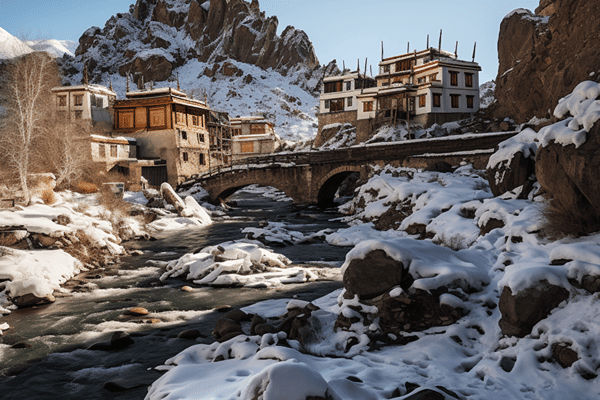
Snowfall in Ladakh is real, but much lighter than most people expect. Leh sits in the rain shadow of the Great Himalaya, so the town gets only a few light spells each winter, usually from December to February. Each spell leaves a few centimeters that melt off sunny roofs and roads within a day or two.
The deep snow lies higher and further west. The passes, such as Khardung La and Chang La, sit under metres of snow. Zanskar is snowbound for months, and Dras, near Zoji La, is one of the coldest inhabited places on earth. If you want snow on the ground, January and February are the surest months. If you want to stand in falling snow, you need a flexible plan and some luck.
Snow also affects flights, road access and pass closures, so timing your visit matters as much as choosing where to go. If you're planning a winter trip, explore our Ladakh tour packages to find an itinerary that fits the season and current travel conditions.
Winter Ladakh trips from WanderOn

Frozen Pangong Tso, Snow Passes & Nubra Adventure in Winter

Best Ladakh Package with Flights – 5-Day Scenic Escape

6 Days Best of Leh with Nubra Valley and Pangong Lake
Does It Snow in Ladakh?

Yes, it does snow in Ladakh, but Leh itself is a cold desert. The town gets about 100 mm of rain and snow in a whole year, and only 5 to 10 mm of that falls in each winter month. As a rough rule, 10 mm of water makes about 10 cm of snow, so a snowy January in Leh adds up to a few short spells rather than a season of drifts.
The reason is geography. Winter snow in this part of the Himalaya comes from western disturbances, storm systems that move in from the west. They drop most of their moisture on the Kashmir side and the high ridges around Zoji La and Dras before they reach the Indus valley.
By the time the clouds cross into Leh, there is little left. For the same reason,snowfall in Manali is far heavier, because Manali faces the storms instead of sitting behind the mountains.
Ladakh still looks white all winter because of the cold. Leh's January nights average about −11 °C, a degree colder than December, and the coldest can reach −20 °C, so the snow that does fall on the mountains around the town stays there until spring.
Where Ladakh's Snow Actually Lives

Snow in Ladakh depends on height and on how far west you are. The higher and further west you go, the more snow you will find.
Area | Typical winter snow | What it means for you |
Leh town and the Indus valley | A few light spells, a few centimetres each | Roads in town stay open; snow melts on sunny roofs within a day or two |
High passes (Khardung La, Chang La, Wari La) | Deep snow from autumn to spring | Open most days, closed for hours or days after heavy snow |
Zanskar | Heavy snow; road passes shut for months | Reached in winter mainly for the Chadar Trek |
Dras and Zoji La | Heaviest snow in Ladakh | Highway closures; extreme cold |
Pangong, Nubra and Tso Moriri | Light snow; frozen lakes and white ridges | Reachable over snowy passes with the right vehicle |
Snowfall in Leh Town

Snowfall in Leh usually comes as a quiet overnight fall. You wake to white rooftops, white poplars, and a white Shanti Stupa against a blue sky, and by the afternoon the south-facing roofs are dripping. Sunny roofs and roads are usually clear within a day or two. Shaded lanes, north-facing slopes, and the fields around Leh hold the snow much longer, often for weeks in January.
A snowy morning is the best time to walk up toShanti Stupa, when the town below is white and the Stok range is lit by the early sun. Go before the sun climbs, because the paths turn icy once the snow starts to melt and freeze again.
The High Passes

The passes are where the snow piles up. Khardung La on the road to Nubra, surveyed at about 5,359 metres, and Chang La on the road to Pangong get far more snow than Leh, about 2,000 metres below.
The Border Roads Organisation keeps both passes open through the winter, so the road overKhardung La is usually driveable, but a heavy fall can close it for a few hours or a few days while ploughs clear it. Drivers heading to Nubra check the status at the South Pullu checkpoint before the final climb, and the police turn traffic back when the top is shut.
The same is true of the road east over Chang La to Pangong, which often has packed snow and black ice near the top from November to March. This is why a pass can be shut while Leh has clear skies, and why winter drivers carry chains and leave early, before the afternoon wind picks up.
The quieter route to Pangong via Wari La is higher and less used, so it is often the last to be cleared after snow and rarely makes sense in deep winter.
Zanskar in Winter

Zanskar in winter is the snow and ice heartland of Ladakh. The valley lies south of the main Ladakh range, high enough and far enough west to catch much more snow than Leh. Its road passes, Pensi La towards Kargil and Shinku La towards Lahaul, are snowbound for months each year.
In winter, its villages settle into a long, quiet season with very few visitors. Families move into the warmest room of the house, livestock stays in the stables all winter, and the barley, butter and dried vegetables stored in autumn last until spring. Remote monasteries such asPhugtal Monastery, built into a cliff, are reached only on foot.
The best-known way into Zanskar in winter is on the river itself. In January and February the Zanskar river freezes hard enough to walk on, and the route along it, the Chadar, runs between snow-covered cliffs. It is a demanding trek on ice in temperatures of −20 °C and below, with permits, health checks, and a fixed season, all set out in ourguide to the Chadar Trek.
Dras, the Coldest Place in Ladakh

Dras is the exception that gives Ladakh its reputation for snow. It sits at about 3,300 metres just east of Zoji La, the first village the western storms reach after they cross the pass. It gets the heaviest snow in Ladakh, and the cold is extreme: a reading of about −60 °C was reported in 1995, and winter nights below −20 °C are common. That is why Dras is often called the second coldest inhabited place on earth.
Snow in Dras is measured in metres, and the village is cut off for spells when Zoji La shuts. Our guide to theDrass valleycovers what there is to see once the road opens, from the Kargil war memorial to the meadows around the village. Summer is the best time to visit, when the grass turns green on the slopes, the road from Srinagar is open and the war memorial holds its July ceremonies.
Further east, Kargil is the main town on this side of Ladakh. It sits lower and gets less snow than Dras, but more than Leh.
Snow at Pangong, Nubra and Tso Moriri

The lakes and valleys beyond the passes get light snow, much like Leh. What changes in winter is the cold. From January, Pangong Tso freezes over, and its frozen surface between white ridges is one of the great winter sights of Ladakh. Ice on the lake can look solid well before it is safe, so only walk on it where local drivers and guides confirm it. Most winter visits go as a long day trip from Leh or with one night at a heated homestay near the shore.
In Nubra Valley, you can see sand dunes and snow-capped peaks in the same view. A dusting on the dunes at Hunder is rare but memorable.
Tso Moriri is higher and colder still, and most of its homestays close for the winter.
Which Month Has Snowfall in Ladakh?

Ladakh in December to February is the core of the region’s snow season. Here is how the year usually runs, based on Leh's climate normals and recent seasons.
Months | What to expect |
September to October | First snow on the passes; Leh stays dry |
November | First spells at Dras and Zoji La; light snow on the passes; Leh is usually dry and cold |
December | Leh's first dusting often arrives; passes snowy |
January | Coldest month; light spells in Leh; snow stays longest |
February | Light spells; snow cover still reliable |
March | Spring storms still possible; Zoji La can close for days |
April to May | Late snow on the passes; roads reopen |
June to August | Occasional summer snow on the highest passes |
In the 2026 to 2027 season, the first moderate snowfall reached Dras and Zoji La on 30 October 2026, and traffic on that stretch then ran to a schedule. That fits the usual pattern, with Leh's own first spell coming later.
Be careful with news reports, too. A headline about snow in Ladakh usually describes one spell, often at Zoji La, Dras or the passes, rather than the season in Leh. Zoji La reopened on 15 March 2026 after a six-day snow closure, and it shut again after fresh snow on 20 April 2026.
Seeing Snow vs Catching Snowfall

These are two different goals, and they need different plans.
•Seeing snow: if you want white landscapes, come in January or February and look up. The mountains around Leh, the passes and the frozen lakes are reliably white, and a drive over Khardung La or Chang La almost always means snowbanks at the top.
•Catching snowfall: if you want to stand in falling snow, you need luck and time. Leh may only get a few snow days a month, even in January. Stay five days or more and watch the forecast for a western disturbance moving in.
•Avoiding snow: if you want the passes open and the roads dry, June to September is the better pick, when the snow is only on the peaks.
How Snow Affects a Ladakh Trip

•Flights: flights into Leh mostly land in the morning, and snow, low cloud or poor visibility can delay or cancel them. Book a flexible ticket and keep a spare day at the end of your trip.
•Roads in Leh: town roads and the highway to Thiksey and Hemis are usually cleared within hours, though shaded stretches stay icy.
•The passes: a closure after fresh snow can hold you on one side of Khardung La or Chang La, so plan Nubra and Pangong for the middle of your trip, not the last days.
•The highways in: the Manali Leh road closes from about November to May. It shut in November 2025 and was cleared in May 2026.
•Zoji La: the road from Srinagar viaZoji La stays open as late as it can. It closes after heavy falls and opens in timed slots between them. The tunnel under the pass was dug through in June 2026 but is not due to open until 2028. Check the status at the Sonamarg or Gumri checkpoints before you set out.
Snow does not change the altitude. Rest for the first two days after you land, even if a white morning tempts you outside, and drink plenty of water even when you do not feel thirsty. The cold makes headaches and breathlessness worse, so learn the signs ofacute mountain sickness before you go.
Snow Photography Tips for Ladakh

The clearest light of the winter comes just after a snowfall, when the sky turns deep blue.
•Timing: shoot at first light after a spell, before the wind lifts the fresh snow off the ridges and the sun melts the rooftops.
•Exposure: cameras tend to underexpose snow, so add one to two stops of exposure compensation, or the white comes out grey.
•Batteries: cold drains them fast. Carry spares in an inside pocket and swap them often.
Snow Activities in Ladakh

Ladakh's snow season brings three things you cannot do in summer: snow leopard tracking in Hemis National Park, ice hockey on Leh's frozen rinks and the Chadar Trek on the frozen Zanskar river.
Frequently Asked Questions
Does it snow heavily in Ladakh?
Not in Leh, where winter snowfall is light and comes in short spells. Heavy snow falls at the high passes, in Zanskar and around Dras and Zoji La.
Which months have snowfall in Leh?
Leh's snow usually falls from December to February, with January the coldest month. Light spells are possible from November and into March.
Why does Leh get less snow than Manali?
Leh sits in the rain shadow of the Great Himalaya. Winter storms drop most of their snow on the Kashmir and Himachal side before they reach Ladakh, while Manali faces them directly.
Where is the heaviest snow in Ladakh?
The heaviest snow falls around Dras and Zoji La, at the western edge of Ladakh. Zanskar and the high passes such as Khardung La and Chang La come next.
Can flights to Leh get cancelled due to snow?
Yes. Snow, low cloud and poor visibility can delay or cancel flights to Leh, sometimes for a day or two.
Is Dras really one of the coldest places on earth?
Yes, Dras is often called the second coldest inhabited place in the world. A reading of about −60 °C was reported there in 1995, and winter nights below −20 °C are common.
How long does snow stay on the ground in Leh?
On sunny roofs and roads, snow usually melts within a day or two. In shaded lanes, on north-facing slopes and in open fields, it can last for weeks in January.
Do Ladakh's passes close because of snowfall?
Yes, for hours or days after a heavy fall. Khardung La and Chang La are kept open in winter, while the Manali road closes from about November to May.
Can you see snow in Ladakh in November?
Yes, on the passes and the peaks around Leh. Snow in Leh town itself is less common in November, and most years the first spell there arrives in December.
Is Zanskar snowier than Leh?
Yes, much snowier. Zanskar gets heavy winter snow that closes its road passes for months, while Leh gets only light spells that melt off sunny roofs within a day or two.